A lot has changed for me in recent years.
I got divorced. I explored working full time for two different non-profits. Somewhere in the process, I got a bit lost.
For the first time in my life, I was discovering what it actually felt like to live free from abuse and abusive people. It was profound and freeing and overwhelming all at once. I took time to figure out what I actually liked doing and what I wanted my life to look like when I wasn’t constantly bending myself around someone else’s needs or expectations.
One of the things I discovered is that financial security matters deeply to me. So I tried building a more stable life by piecing together full-time work through two different non-profits. And honestly, I learned a tremendous amount from that experience. I found meaningful work, good people, and many opportunities to use the skills I developed through philosophy in practical ways.
But over time, I realized that balancing my desire for meaningful work with my need for stability was consuming my entire existence.
Meaningful work is intoxicating for me. Much like an alcoholic, I will let it overtake my whole life. I will sacrifice rest, spaciousness, relationships, contemplation — all in the name of working for the greater good.
That was an important thing to learn about myself.
And after an unexpected tragedy struck and one of my bosses suddenly passed away, I had to step back and ask myself some difficult questions.
- What does it actually mean to live a good life?
- Can a life lived at this intensity leave room for the kind of person I want to become?
- And perhaps most importantly: Is this the work I am most deeply called to do?
Without fully realizing it, I found myself putting my philosophical counselor hat back on. I was using philosophy as a tool for honestly examining my own life. And the more I reflected, the more I realized:
I didn’t just want meaningful work. I wanted philosophy itself to be center stage in my life again. I wanted philosophy as lived practice — philosophy that helps ordinary people think through the real challenges of being alive.
Because during my years working in universities, and later while immersed in nonstop non-profit work, I noticed the same thing again and again:
People are hungry for spaces where they can think deeply together about the questions that actually matter to their lives because they are trying to figure out:
- how to live,
- what matters,
- how to respond to suffering,
- what kind of life is worth building.
I realized that I needed to be doing philosophy with people who were living busy, complicated lives like the one I had just been immersed in.
I craved that kind of space during that time. And I know I’m not alone in that.
I remember after my boss passed away feeling this desperate urge to stop. There was suddenly so much practical work to do. Death creates an astonishing amount of logistics, especially inside small organizations. Emails still needed answers. Events still needed coordination. Decisions still needed to be made.
And while all of that was happening, what I really wanted was to sit down with my coworkers and ask bigger questions together.
- What did his passing mean for the work he cared so deeply about?
- What did it mean for those of us trying to carry that work forward?
- What did it reveal about the kind of lives we wanted to live ourselves?
- How were we supposed to understand the future after something like that?
But we rarely had space for those conversations. We just kept moving.
And I remember feeling, very deeply, that something important was missing. I realized I wasn’t just craving rest. I was craving space to reflect together on what any of this actually meant.
One of the ways I quietly snuck philosophy back into my life during this period was by hosting a philosophy club through one of the organizations I worked for. We held discussions centered around philosophical questions connected to the real experiences our community was facing together.
At one point, there were conversations about two local groups combining together to build a shared space on the land owned by the organization. When that project eventually fell through, our next Philosophy Club centered around the question:
“Who are we without the building?: An invitation to rethink what makes a community real.”
And I loved the experience.
I watched people engage their real lives through philosophy in real time. I watched friendships deepen as people reflected together on difficult questions. I watched individuals pick up entirely new perspectives and genuinely wrestle with them alongside their peers.
The magic of that collective engagement with philosophy made me feel alive.
Something that can be difficult as a philosophical counselor is that I often use philosophy so naturally that I forget I’m even doing it. It’s become almost like breathing for me after years of practice.
But Philosophy Club allowed me to watch something extraordinary happen in real time: people discovering the power of a new perspective together.
And people seemed genuinely hungry for it.
Where else do adults regularly get to step back from the chaos of ordinary life and thoughtfully explore meaningful questions together in a supportive and curious environment? The more I reflected on all this, the more I found myself returning to Socrates.
Usually considered one of the foundational figures of Western philosophy, Socrates was not an academic in the modern sense. He wandered the marketplace engaging ordinary people in conversation. He asked questions and challenged assumptions. He helped people examine the way they were thinking about their own lives. We only know about Socrates through the writings of his student Plato, so I decided to revisit some of those dialogues myself.
What struck me most was his engagement directly with the experiences and assumptions of ordinary human beings.
Now, to be fair, I don’t love everything Socrates is doing in these dialogues. There is definitely some “bro” energy paired with more than a little “gotcha” energy. Combined with his tendency to belabor a point, I’ll admit that at times it starts to make sense why the guy was sentenced to death by hemlock.
But underneath all of that, there is something deeply compelling happening there.
Socrates was creating philosophy in public life.
And that feels much closer to the kind of philosophy I want to practice.
I want to recover the spirit of the agora without the performative “gotcha” energy that so often dominates modern discourse. I want to create spaces where ordinary people can thoughtfully explore meaningful ideas together with curiosity, humility, and genuine care for one another.
That is what Philosophy Club began to feel like to me. And honestly, it feels more important now than ever.
We are living in turbulent times. Authoritarianism is rising around the world. Social media increasingly traps us in isolated ideological bubbles. Many people feel profoundly disconnected from one another, from themselves, and from any deeper sense of meaning or direction.
I don’t know how much impact one small philosophy club can have against forces this large.
But I do know this:
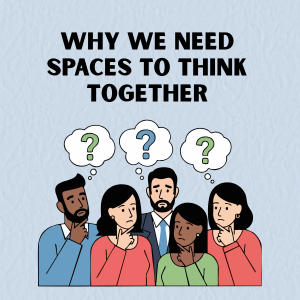
If we are going to make it through the road ahead, we are going to need spaces where human beings can think together again.
I believe deeply that community is part of how we survive difficult times. And I have found that one of the most powerful ways to deepen connection with another human being is to sit together and thoughtfully wrestle with an important shared question.
So after reorganizing my life around something more sustainable — and more aligned with what genuinely calls to me — I’ve decided to formally bring Philosophy Club into Empowerment Through Thought.
I will continue offering one-on-one philosophical counseling sessions, because I believe deeply in the transformative power of personalized philosophical reflection.
But I also want to create something communal.
An in-person space here in South Bend Indiana where people from across the Michiana area can gather to think together, challenge themselves, deepen their understanding, and perhaps even shift how they relate to the world and one another.
I especially hope to reach people like the version of myself I encountered during those years of nonstop work:
- people who are longing for deeper reflection,
- people who suspect there must be more to the good life than simply grinding to survive,
- people who want to make space for contemplation but struggle to carve it out alone.
I don’t think philosophy belongs only in classrooms or books.
I think it belongs in ordinary human life.
And I think we need spaces to practice it together.


Leave a comment