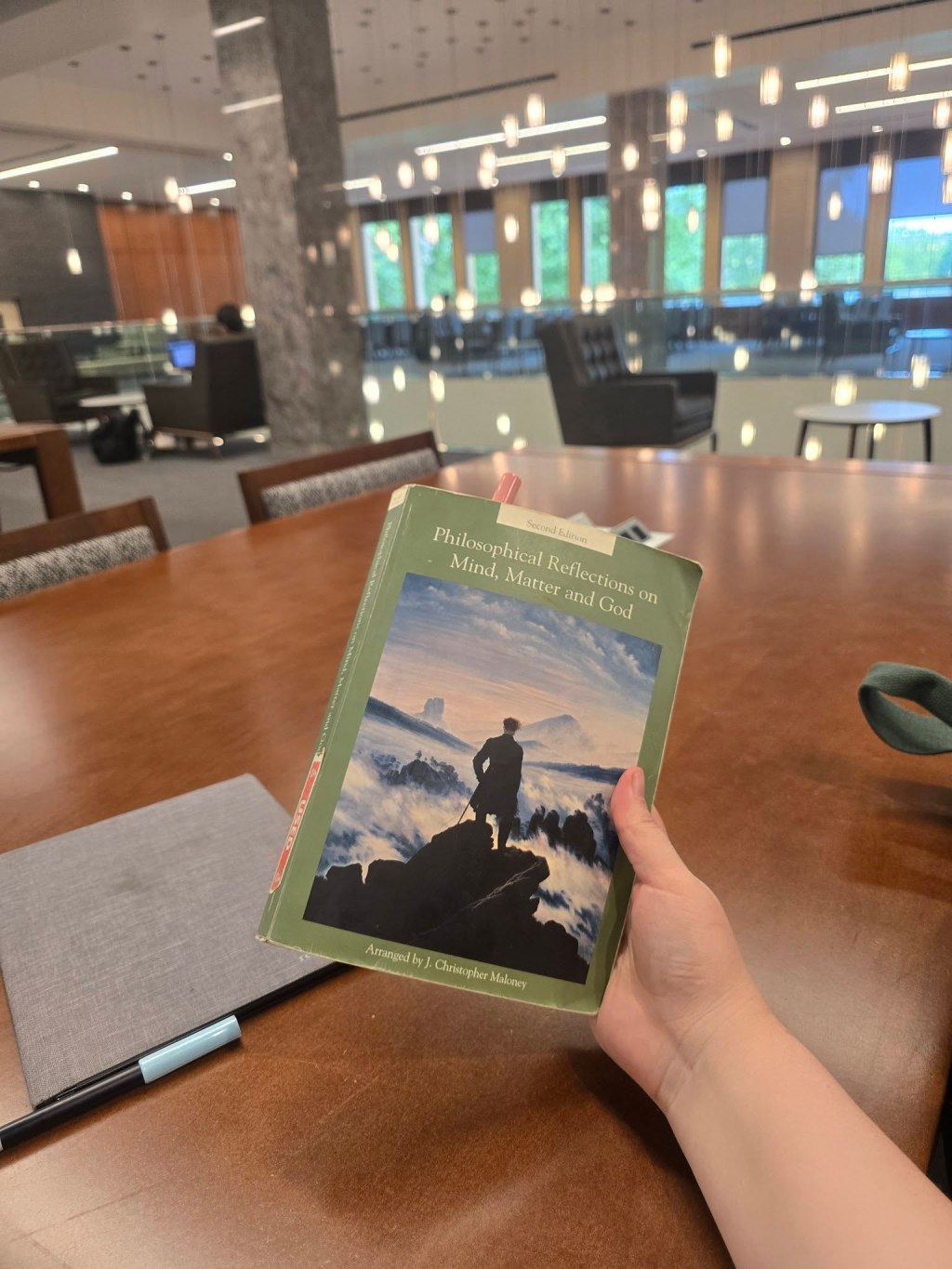
Today I felt called back to Hesburgh. It’s the main library at Notre Dame. Every so often I hear it calling me.
My relationship with academia is complicated. I grew up in it. I came to know and love philosophy in it.
But today my philosophical counseling work is pushing me to envision a kind of philosophy that exists outside the bounds of academia.
This isn’t a new idea. You might think of Socrates arguing with folks in the Agora as philosophy outside of academia.
But today philosophy lives primarily in the Ivory Tower.
I recently hosted the first meeting of a local, in-person Philosophy Club. We had a great time exploring what building meaning in uncertain times looks like. And I could feel the tension I’ve been dancing around sitting in the room with us.
See, the vision I have for philosophy is one that doesn’t require participants to dedicate loads of time to close readings of dense texts. But because this is so central to how philosophy is taught, people hear the word philosophy and naturally assume that’s the activity at hand.
Now don’t get me wrong. I am all for a close reading of a dense text. That just isn’t what I want to bring to folks.
So what am I trying to bring?
To be honest, I know a lot more about what it is not than what it is. That’s one reason I started Philosophy Club. I need to get out in the streets with real people doing the thing so I can better articulate what it is.
Here is what I know so far.
The end goal is for people to actually live more philosophically in their everyday lives.
That is a different goal than mastering what Plato thought in the Republic.
Philosophy is a way of understanding the world. You can bring that way of understanding to whatever question feels pressing in your own life.
It’s this way of engaging the world that I believe is so deeply needed right now.
Yes, Plato absolutely has insights that are useful in this moment. But whether someone attending Philosophy Club masters those ideas or not, the ability to press their assumptions a little further, to deepen a conversation just a little more, to become more comfortable living with difficult questions—that’s what I hope makes the difference.
In a world of instant gratification and endless streams of brain rot, we need to learn how to puzzle deeply about the world we are living in. Not because we need crystal-clear answers, but because the very act of deeper inquiry helps us live better.
I’ve gone viral on Instagram sharing tiny tidbits of philosophy. I know those ideas have helped people. But the structure of short-form content is brutal for philosophy.
I need your focus. I need your energy. I need us to be whole human beings connecting with one another for this thing to work.
I’ve shifted from running my philosophical counseling practice primarily through social media to building it in person. Magic happens when two human beings come together to do philosophy about things that actually matter in their everyday lives. And a different kind of magic happens when we do it together in a group.
The thing I’m focused on has always existed within the history of philosophy. It exists in academic philosophy too. But the vision I have for philosophy is different from the way philosophy is usually practiced in academia.
I’m still sorting out the details.
I don’t have a finished answer yet. But philosophy has made me increasingly comfortable with that fact. It has taught me that there is value not only in finding answers, but in learning how to live well with difficult questions.
I’m grateful for everyone who has helped me get to this point. Academic philosophy is deeply a part of who I am, and I am still becoming something new. Everyone who has practiced philosophy with me has been a part of that, and I appreciate all of you—even, and especially, when things get a little messy.


Leave a Reply